Alegria: The Ancient Grain of Resistance and Indigenous Joy
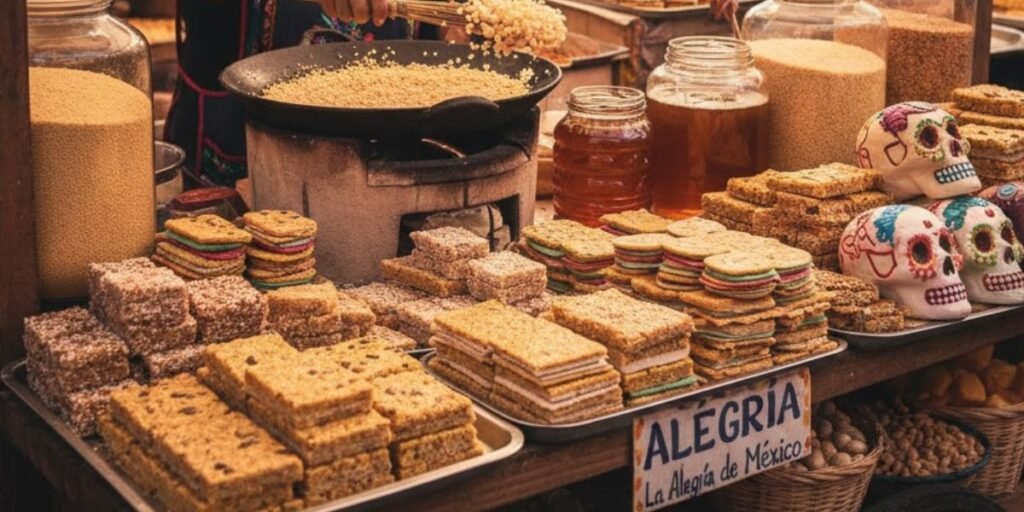
If you have ever walked through the bustling street markets of Mexico City, you have likely seen colourful, rectangular bars studded with seeds, nuts, and sometimes bright wafers. To the casual traveller, it looks like a simple granola bar. But to a local, it is Alegria, a treat whose name literally translates to Joy, and whose history is a 5000-year-old story of survival, spirituality, and defiance. This is not just a candy; it is a survivor of a 16th-century war on plants. To truly understand Alegria, you have to look at it as more than just a snack; it is a symbol of Mexican resilience. When the Spanish prohibited amaranth to dismantle Aztec religious life, the indigenous people preserved the plant by turning it into this joyful candy, which was less threatening to the authorities than the sacred statues they once carved from it.
The Sacred and Forbidden Origins of Tzoalli
Long before the Spanish arrived, the Aztecs called amaranth huauhtli. It was more than a staple crop; it was a deity. Before it was a candy, Alegria was a sacred substance known as tzoalli. For the Aztecs, the amaranth seed was more precious than gold. They ground it into flour, mixed it with honey or agave sap, and sculpted life-sized effigies of their gods, specifically Huitzilopochtli, the god of war, during religious ceremonies. After the ritual, the flesh of the god was broken into pieces and eaten by the faithful in a ritual of consuming the divine. This practice so closely resembled Catholic Communion that the Spanish conquistadors outlawed amaranth cultivation entirely.
When the Spanish conquistadors arrived, they viewed this practice as a pagan parody of the Catholic Eucharist. In an attempt to dismantle Aztec religion and culture, they banned the cultivation of amaranth on pain of death. Those caught growing it faced brutal punishments, including the loss of their hands. The plant nearly went extinct, preserved only in secret, remote mountain plots. Eventually, the grain re-emerged under the name Alegria. By rebranding it as a simple joyful sweet, indigenous families were able to keep their sacred tradition alive right under the prying eyes of the Inquisition. The plant was nearly lost to history over the millennia until it was renamed to disguise its sacred origins.
The Cultural Heartland of Santiago Tulyehualco
While amaranth grows across Mexico, the town of Santiago Tulyehualco in Xochimilco, Mexico City, is the spiritual and literal heart of the tradition and the world capital of Alegria production. In 2016, the Alegria produced here was officially granted Intangible Cultural Heritage status by Mexico City. This protects the traditional millenary methods and ensures the alegrilleros, the families who have made it for generations, are recognized. True Alegria is still made by hand-popping seeds on a clay comal.
The town hosts the annual Amaranth and Olive Fair every February to celebrate the artisans who keep 16th-century techniques alive. Here, they still grow amaranth in chinampas (floating gardens) and thresh the plants by hand. Local lore says a Franciscan monk named Fray Martin de Valencia saw people dancing and singing while preparing the toasted amaranth and exclaimed, Que alegria! (What joy!), giving the candy its modern name.
Complete Nutritional Profile: The Smallest Giver of Life
The Aztecs called amaranth huautli, meaning the smallest giver of life, and modern science confirms this density. Amaranth is often called a pseudo-cereal because its nutritional profile is far superior to most grains like wheat or rice.
Nutritional Analysis per 100g of Amaranth Grain: Energy: 371 kcal Protein: 14g to 16g Total Fat: 7g (primarily polyunsaturated omega-3 and omega-6) Carbohydrates: 65g Dietary Fibre: 7g Lysine: 0.75g Iron: 7.6mg (95% Daily Value) Magnesium: 248mg (59% Daily Value) Calcium: 159mg (16% Daily Value) Phosphorus: 557mg (80% Daily Value) Manganese: 3.3mg (145% Daily Value) Squalene: Approximately 5% of the total oil content
Nutritional Profile per Average Alegria Bar (60g): Calories: 230 kcal Protein: 6g Fat: 2g to 4g Net Carbohydrates: 46g Sugar: 27g (from piloncillo and honey) Iron: 3mg (approx. 34% Daily Value) Calcium: 60mg (approx. 6% Daily Value)
Complete Protein Content: Amaranth is a complete protein, meaning it contains all nine essential amino acids. This includes lysine, which is rare in plant-based foods and helps the body absorb calcium and build muscle. This makes it comparable to animal milk or meat.
Squalene: Amaranth is a rare plant source of squalene, an organic compound used in high-end skincare and vaccines for its powerful antioxidant and immune-boosting properties.
Essential Minerals: Alegria is one of the few candies in the world that provides significant levels of iron, magnesium, and calcium. Because it is lightweight, energy-dense, and easy to digest, it remains a staple of high-performance diets.
The Artisan Science of the Pop
Making Alegria is a delicate science known as the dance of the seeds. Unlike corn, which has a thick hull that creates a loud bang, amaranth seeds are tiny and require precise, dry heat. Artisans use a clay griddle called a comal. They add only a teaspoon of seeds at a time to an extremely hot surface, about 250 degrees Celsius. Within 5 to 10 seconds, the tiny brown seeds frolic, jumping and turning snow-white as they puff into miniature clouds.
The difficulty lies in the timing; if the pan is too cold, the seeds just toast and turn bitter; if it is too hot, they burn instantly. It requires constant rhythmic shaking using a wooden paddle or a bundle of dry fronds to keep the seeds moving. Once puffed, they are mixed with a warm syrup of piloncillo and honey, then pressed into wooden molds while still warm.
Traditional Alegria de Amaranto Recipe
Yields: 12-15 bars Prep time: 20 mins Total time: 45 mins
Ingredients: 5 cups popped amaranth seeds 450g (1 lb) piloncillo, chopped 2 tablespoons honey or agave syrup 1 tablespoon fresh lime juice 1/2 cup toasted pepitas (pumpkin seeds) 1/2 cup chopped walnuts or peanuts
Instructions:
- Prepare the Tray: Line a 9×9 inch baking pan with parchment paper.
- Make the Syrup: In a heavy saucepan, combine the piloncillo, honey, and lime juice. Cook over medium heat, stirring constantly until the piloncillo is fully melted and begins to bubble.
- Reach the Hard Ball Stage: Heat the syrup until it reaches approximately 120 degrees Celsius. The syrup should be thick, dark, and smell of caramel.
- Mix the Dry Goods: In a large heat-proof bowl, combine the popped amaranth and nuts. Pour the hot syrup over the dry mix.
- Press Quickly: Working fast before it sets, stir with a wooden spoon until every seed is coated. Transfer the mixture to your tray.
- Set: Press the mixture down firmly into an even layer. Wetting your hands with cold water can help prevent the syrup from sticking to your skin.
- Cut and Cool: Let it cool for 15 minutes. While still slightly warm, use a sharp, wet knife to cut into rectangles. Let cool completely before serving.
Local Craft in British Columbia: BC Amaranth
In British Columbia, the craft is kept alive by BC Amaranth. If you are in the Okanagan or Shuswap, you can find these handmade bars every Saturday in Armstrong.
- Winter Location (Nov – April): Odd Fellows Hall (3005 Wood Avenue), Saturdays from 10:00 am – 1:00 pm.
- Summer Location (April – Oct): IPE Fairgrounds (3375 Pleasant Valley Road), Saturdays from 8:30 am – 12:30 pm.
The Flavour Profiles:
- Carob: A rich, earthier sweetness that mimics chocolate without the caffeine. It is complex, nutty, and naturally less bitter than cocoa.
- Cinnamon: A warm, nostalgic profile. BC Amaranth uses this to highlight the toasted, nutty notes of the puffed grain, echoing traditional Mexican spices.